

← Back to Articles
Proposals

Construction proposal, estimate, and quote — what's the actual difference?

May 14, 2026 • 8 min read

Construction proposal, estimate, and quote — what's the actual difference?
Dean Loader Dean Loader

An estimate is a ballpark cost to help the client plan. A quote is a fixed-price offer you're committing to. A proposal is the full pitch — scope, pricing, terms, sometimes design. Here's when an Australian builder should send each one, and why getting it wrong creates legal exposure.

In this article

  1. What's the difference between a construction estimate, quote, and proposal?
  2. When should an Australian builder send an estimate?
  3. When should you send a quote instead?
  4. When does a proposal make sense?
  5. What does Australian consumer law actually say about each?
  6. How should builders use these in practice?
  7. Frequently asked questions

What's the difference between a construction estimate, quote, and proposal?

Three documents. Builders use them almost daily. Most use the words interchangeably, and in residential work that rarely causes problems — until it does. The legal and commercial difference matters. Here's the plain-English version.

When should an Australian builder send an estimate?

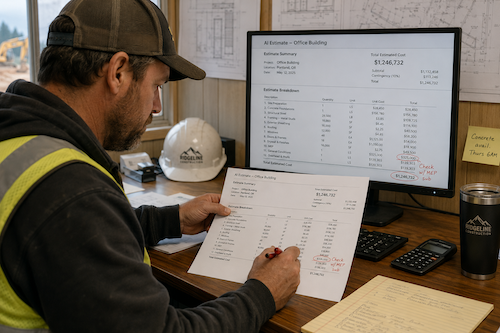
An estimate belongs early in the conversation — before scope is locked, before you've done a full take-off, before the client has decided whether this project is even going ahead.

You're giving the client a rough sense of cost. They're using it to decide whether to proceed, whether they need to redesign to hit budget, or whether they're shopping around.

When an estimate is the right call

Client is exploring, not ready to commit. Scope isn't firm — "we're thinking about a two-bedroom extension but haven't got plans yet". Indicative pricing for feasibility — developer running early numbers, architect testing budget before design development. Early conversation where you want to qualify the job before spending time on a full quote.

The risk

Clients don't always read document titles. An estimate sent by email can get treated like a quote if you're not explicit about what it is. The fix is simple: add a line at the top — "This is an indicative estimate only. Not a fixed-price offer. Scope and pricing will be confirmed at quote stage once detailed plans are available." Put that line on every estimate you send.

When should you send a quote instead?

A quote is where most residential work lives. Scope is firm, you know what you're building, and you're committing to a price.

Once a client accepts your quote, you're generally bound to it under Australian consumer law. That's not a problem if your quote is well-priced and your scope is clear. It is a problem if you've quoted loose, materials have moved since you priced it, or you've left things ambiguous.

When a quote is the right call

Plans are final and scope is clear. You're ready to commit to a specific price for the described work. Standard residential scope — kitchen renovation, bathroom, deck, extension, custom build. The client is making a buying decision, not a planning decision.

Quote validity matters

Material prices move. 14–30 days is standard for Australian residential work. Always include a "valid until" date — it's both a legal protection and a professional signal. Per business.gov.au's guidance on preparing quotes, your quote should be clear about exactly what's included, what it costs, and how long it's valid.

When does a proposal make sense?

A proposal is a quote with packaging. It includes the price, but it also tells the story of why you're the right builder for this job.

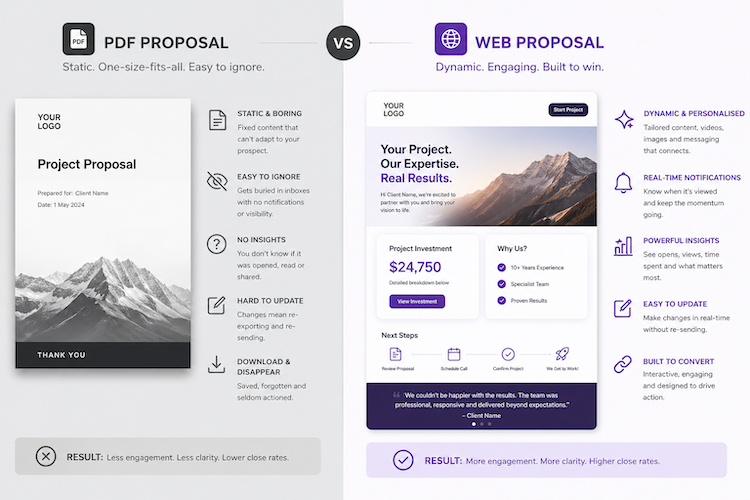
For most residential work, a quote is enough. A proposal makes sense when: the job is competitive — the client is comparing multiple builders and the decision isn't purely on price; the job is high-value or complex — architect-designed home, large renovation, a project where the client has invested heavily in design and expects the same standard from the builder; presentation signals capability — a professional proposal for a $450k custom build positions you differently from a PDF quote; clients notice; you want to include scope narrative, past work examples, terms, and payment schedule in one document.

A well-produced proposal closes better on competitive jobs. It's not a pitch — it's a complete picture of what you're offering and who you are as a builder. Core Estimator's web proposals are built for exactly this — professionally presented, live-view, and trackable.

What does Australian consumer law actually say about each?

This is where mislabelling creates real exposure.

Under Australian Consumer Law, a quote is generally treated as a fixed-price offer once accepted. The builder is held to the quoted price for the described scope. A clearly defined scope means the price sticks — variations to the original scope are priced separately.

An estimate isn't legally binding in the same way — but only if it's clearly labelled as one. If the wording is ambiguous, or if you've referred to an estimate as a quote across a chain of emails, the line blurs in ways that are expensive to argue later.

Consumer Affairs Victoria's building and renovating guidance is worth reading. The same rules apply in other states, administered under the national Australian Consumer Law framework. The ACCC's consumer guarantees guidance sets out the broader framework.

What this means in practice

Send an estimate? Label it clearly. Add the indicative-pricing disclaimer every time. Send a quote? Make sure the scope is unambiguous. Scope creep starts with a quote that didn't define what was and wasn't included. Proposal terms become contract terms on acceptance. Your payment schedule, defect liability period, and variation process all land in a proposal — read them carefully before sending. Document title matters in a dispute. Getting it right is cleaner than arguing about it later.

For builders who want to understand the fixed-price risk side in more depth, it's worth reading about why fixed-price quotes carry extra risk in 2026.

How should builders use these in practice?

Here's the simple framework:

Early conversation → estimate. Client is still deciding. Scope isn't locked. Give them a rough sense of cost, be explicit it's indicative, and don't spend hours on a document that's really helping both of you decide whether this job is worth pursuing.

Scope locked, ready to commit → quote. Plans are final. You know exactly what you're building. Clear scope, clear price, validity period, payment schedule. Get it in front of the client.

Competitive or high-value job → proposal. Same numbers as the quote, but packaged up with your story. You're bidding against other builders. The proposal is what separates being chosen on price from being chosen on confidence.

Variation during the job → written variation order. Once the original scope is accepted, any change to it should be documented and agreed before the work is done. The labelling discipline at the start pays off here — if the original quote scope was clear, the variation conversation is clean.

The integrated workflow: an estimate becomes a quote as scope locks down. A quote becomes a proposal when a job becomes competitive. The underlying data is the same — the commitment level and packaging change. The estimating workflow and proposal tools in Core Estimator are built around exactly this progression.

Frequently asked questions

What's the difference between an estimate, quote, and proposal in construction?

An estimate is a rough cost to help with planning — not legally binding, provided it's clearly labelled as an estimate. A quote is a fixed-price offer the builder commits to once the client accepts. A proposal is the full package: scope narrative, pricing, terms, past work, sometimes design. Used for competitive or high-value jobs. The difference matters legally and commercially in Australia.

Is a construction quote legally binding in Australia?

Generally yes — under Australian Consumer Law, a quote is a fixed-price offer once accepted. A formal building contract (HIA, MBA) can modify this position; those contracts typically include specific variation, latent conditions, and cost-escalation clauses that govern what can change and at what price. Outside a formal contract, the default position is that the builder is held to the quoted price for the described scope. Variations to the original scope should be documented and agreed before work proceeds regardless of contract type.

Can I send an estimate and treat it like a quote?

No — and the reverse risk is bigger. If you send something labelled "estimate" but the client treats it as a binding price, you can be held to it. Be explicit every time: label estimates as estimates and include a disclaimer that the price is indicative, not a fixed-price offer.

Should I send an estimate, quote, or proposal for a residential renovation?

For most residential renovations once scope is firm — a quote. For early conversations before scope is locked — a clearly labelled estimate. For high-value or competitive jobs (architect-designed homes, large renovations, anything where presentation and confidence matter) — a proposal that wraps a quote inside a fuller scope narrative.

How is a tender different from a quote in construction?

A tender is a structured competitive bid, usually for commercial or government work, with formal selection criteria set by the client. A quote is a price offer for a specific scope — less formal, and how most residential work is priced. Residential builders rarely deal with tenders directly.

What makes a construction proposal different from a quote?

A quote is the price commitment for a defined scope. A proposal includes that commitment plus scope narrative, your business background, similar past work, terms and conditions, and a payment schedule. The quote is the number; the proposal is the whole picture.

How long should a construction quote be valid for in Australia?

14–30 days is standard for residential work. Material prices move, and anything beyond 30 days carries real risk for the builder. Always include a "valid until" date — for legal protection and because a quote without an expiry looks unprofessional.

Can a builder change a quote after the client accepts it?

Not unilaterally. Under Australian Consumer Law, a quote is a fixed-price offer once accepted. A formal building contract (HIA, MBA) will typically include clauses covering variations, latent conditions, and cost escalation — those provisions govern what can change and how. Outside a formal contract, the quoted price is the price. In either case, get any change agreed in writing before the work is done — verbal agreement on a variation is a dispute waiting to happen.

Keep reading

Dean Loader

Written by Dean Loader

Dean Loader spent 25 years as a residential builder specialising in architectural and bespoke work before co-founding Core Estimator. He's been where his customers are — sitting across from clients with a quote that needs to hold, managing variations, and knowing what it costs when a number is wrong.

Subscribe To
Our Newsletter

Receive expert estimating advice, takeoff strategies, and bidding guides every week.

Recent Posts